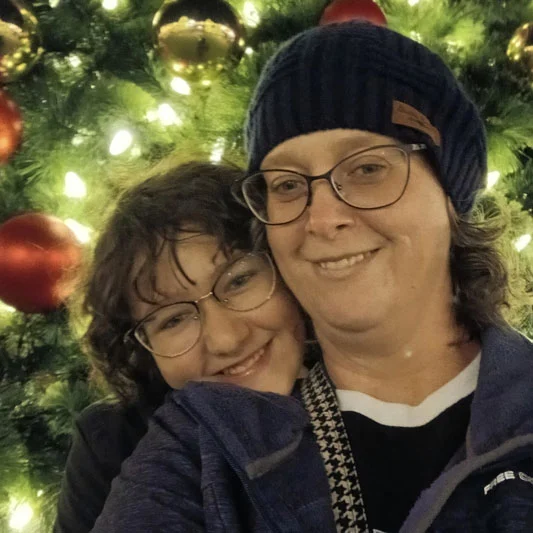
Aimee and her daughter
Aimee
Systemic sclerosis, or scleroderma, an autoimmune disease
When Aimee fell ill in October 2022, she assumed it was just a run of bad luck—three viruses in three months. But even after each infection cleared, she never regained her usual energy.
She was unusually fatigued. Her fingers were swollen. Painful Raynaud’s attacks—episodes in which blood flow to the fingers or toes is temporarily reduced, causing intense pain, numbness, and color changes—became part of her daily life. She visited doctor after doctor, but no one could explain her symptoms.
Thankfully, her new primary care provider suggested she see a rheumatologist whose graduate training at a scleroderma clinic helped her recognize subtle signs that others had missed.
“After examining the skin on my hands and listening to my medical history, she began pursuing a diagnosis that ultimately took six months to confirm—far faster than the years many patients often wait. In April 2023, I finally had a name for what was making me feel so terrible: systemic sclerosis, or scleroderma,” said Aimee.
The diagnosis brought both relief and fear. Systemic sclerosis is a chronic autoimmune disease in which the body produces excessive collagen, causing the skin, blood vessels, and internal organs to thicken and tighten. In Aimee’s case, the disease was taking a noticeable toll on her hands.
Aimee immediately dove into learning everything she could about systemic sclerosis. She joined support groups, connected with her local scleroderma chapter, and learned the importance of seeking care from specialists experienced in the disease.
“My disease continued to progress. My skin was getting very hard and my knuckles were red and inflamed. My tendons in my hands tightened, leading my care team to suggest a CAR T-cell therapy clinical trial at Colorado Blood Cancer Institute (CBCI) under the care of Dr. Richard Nash.”
She had heard a bit about CAR T-cell therapy and how it compared to stem cell transplant, and the idea intrigued her. The possibility of a treatment with less chemotherapy and potentially fewer risks offered a spark of hope.
After further evaluation, Aimee enrolled in the clinical trial, offered at CBCI through Sarah Cannon Research Institute (SCRI) in May 2024.
Despite the hour‑plus drive from Fort Collins, she continued making the trip to CBCI in Denver, bolstered by the unwavering support of her family.
The early phase of treatment was intense: three days of chemotherapy, the CAR T infusion itself, then two to three weeks of close monitoring in the hospital. After discharge, she stayed in a hotel nearby for two additional weeks to remain within an hour of the hospital.
The commitment was enormous. But over time, Aimee felt improvements that made a noticeable difference in her daily life.
Aimee describes experiencing meaningful improvements in how she felt following treatment, including changes in her hands and day‑to‑day symptoms. Aimee remains on the trial and today, more than a year after receiving CAR T-cell therapy, Aimee says that, though fatigue still lingers at times, her day‑to‑day life improved significantly. She returned to work just six weeks after treatment.
Aimee describes the team—Dr. Nash, his staff at CBCI, and everyone involved in her trial—as “top‑tier, gold‑star healthcare professionals.”
“I feel like the stars aligned at exactly the right moment, bringing together the people and the science that supported me during a very challenging time in my life,” said Aimee.
Today, she has profound hope for the future of research in CAR T-cell therapy and other emerging therapies for autoimmune disease.
CBCI offers clinical trial options for blood cancers, blood disorders and autoimmune diseases as well as autologous stem cell transplant for multiple sclerosis, systemic sclerosis, and other severe autoimmune diseases. Before she was diagnosed with systemic sclerosis, Aimee says she never understood how deeply autoimmune diseases can impact someone’s life—or how betrayed you can feel by your own body. After the start of her journey, she feels something else entirely: Thankful. Hopeful. And incredibly grateful for the science and people who are helping to give her life back.